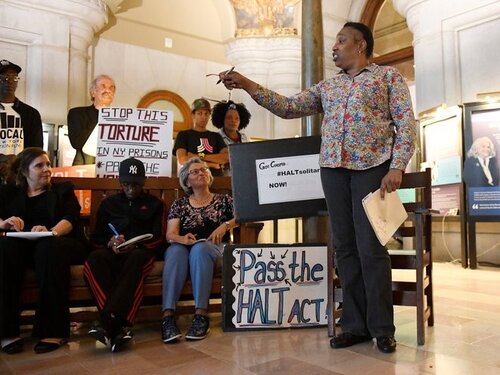
黑料不打烊 Note: Undeterred by Albany鈥檚 unwillingness to enact Human Alternatives to Isolated Confinement (HALT) legislation last session, advocates for the bill gathered in the Albany area this past weekend, laying out an array of strategies to see the bill passed in 2020. I participated in the retreat, making it clear that HALT鈥檚 passage will once again be a major primary of 黑料不打烊鈥� 2020 budget priorities at our February 25th, 2020 Legislative Day.
As you can see below, statewide organizer Victor Pate is at the center of the campaign: 黑料不打烊 is very pleased to be honoring Victor, along with Ron Manderscheid, Sally Zinman, Teena Brooks and Rob Kent at our upcoming annual conference. See more at .
Prison Reformers Regroup to Push Cuomo for 15-Day Limit on Solitary Confinement
By Ross Barkan September 9, 2019
When Democrats seized control of the 黑料不打烊 State Senate last year, criminal justice reformers were optimistic that the new class of progressives would move swiftly to curtail solitary confinement in 黑料不打烊 prisons and jails, a practice increasingly derided as inhumane. By March, a had co-sponsored legislation to restrict the practice.
Instead, amid backroom wrangling, opposition from the powerful correction officers union, and a veto threat from Gov. Andrew Cuomo, the bill , though the effort did win a package of smaller reforms. It was a grievous blow for reformers, who have quietly been strategizing over how to win passage for legislation that once seemed inevitable, but has run up against a powerful governor and skittish legislative leaders who fret over the political and monetary costs of challenging a deeply entrenched correctional practice.
鈥淚 still feel betrayed and my anger has not subsided,鈥� said Victor Pate, the statewide organizer for .
Pate, who was formerly incarcerated and spent time in solitary confinement, is one of the advocates who rallied around the , a bill that would limit the amount of time an incarcerated 黑料不打烊er can spend in solitary confinement to 15 consecutive days (a standard set 鈥� expert on torture). For inmates who need to be separated for longer periods of time, the bill requires them to be transferred to residential rehabilitation units with 鈥渢herapy, treatment, and rehabilitative programming.鈥�
In the days leading up to the end of the 2019 legislative session, advocates went on an to urge the Democrat-controlled assembly and senate to pass HALT and Cuomo to sign it. Curtailing solitary confinement has long been a goal for criminal justice reformers because the practice鈥攚here inmates can spend 23 hours a day locked in a tiny cell, with stays lasting as long as months or even years鈥� on prisoners, including sparking panic attacks and hallucinations.
Though Cuomo, at least in the early months of the legislative session, appeared sympathetic to HALT, he later balked at the bill, citing what he claimed was a potential billion-dollar cost of building new facilities to house prisoners not held in solitary confinement. The Correction Officers鈥� Benevolent Association, a Cuomo ally, is a and has said ending the practice would “invite violence鈥� against officers and inmates.
Proponents of HALT pushed back, arguing the bill could actually because it would drastically reduce the number of people held in solitary confinement. They also contended that concern over small municipalities having to spend money on new facilities is unfounded because the bill explicitly exempts jails with 500 or fewer inmates from those requirements.
In the end, Cuomo and legislative leaders Andrea Stewart-Cousins and Carl Heastie agreed to several administrative changes that will cap solitary confinement at 90 days starting in 2021鈥攁nd 30 days by 2022鈥攁nd prohibited its use on pregnant or disabled inmates. These failed to placate advocates, as an executive order lacks the teeth of legislation, and the measures don鈥檛 go as far as HALT.
(The governor鈥檚 office did not reply to a query about how much the state expects to save from the looser limits on solitary confinement.)
Pate said advocates are planning a far bigger mobilization around HALT for 2020, targeting legislators who already support it, those who are not committed, and the governor鈥檚 office. The coalition鈥檚 initial goal is to ensure HALT is at the front of the Democrats鈥� early agenda, which was overwhelmed last year with a wide range of long-pent-up progressive bills. One hope is to add Senate co-sponsors to increase pressure on Cuomo: now back HALT, though there are 40 in the chamber. (It would take 42 votes to override the governor’s veto.)
Pate said he plans to bring 1,000 supporters of HALT to Albany on the first day of the legislative session, with weekly gatherings to follow, as well as rallies at the district offices of Democrats who back the bill. 鈥淲e need a mass mobilization of people,鈥� he said.
Asked by Gothamist if the governor would reconsider HALT next session, Cuomo spokesperson Rich Azzopardi said only, 鈥淚f there鈥檚 revised legislation, we鈥檒l review it鈥� 鈥� implying that the legislation would have to change in some way to avoid Cuomo鈥檚 veto pen.
State Senator Luis Sep煤lveda, a Bronx Democrat who is a co-sponsor of HALT, said he has visited almost a dozen prison facilities since the end of the legislative session and is planning to convene HALT advocates, representatives from NYSCOBA, and criminal justice experts to discuss a way forward for the legislation. His office is planning to release an analysis based on the visits he has made to prisons. He also hopes to hold a HALT hearing at a correctional facility in the coming months.
鈥淲e had to deal with the governor鈥檚 comments that as the bill is, he would veto it,鈥� Sep煤lveda said. 鈥淗e was pretty adamant he would not sign a bill the way it was written. He came up with some pretty high numbers, even a billion dollars. I respectfully disagree with him.鈥�
Concluded Sep煤lveda, 鈥淲e have to fight another day. And we will.鈥�
For Alicia Barraza, a criminal justice advocate closely involved in the fight to pass HALT, Cuomo鈥檚 rejection was personal. Her son, who was mentally ill, after a ten-day stay in solitary confinement.
For HALT to pass in 2020, she said, advocates must squarely target Cuomo鈥檚 office, which she blames for the bill鈥檚 demise.
鈥淲e need him to see it is not going to cost the tremendous amount of money he鈥檚 claiming it鈥檚 going to cost,鈥� she said.